

Morgan Tunow
July 29, 2026

Silver Award
CATEGORY:
Pysanky/Diaspora
PATHWAY:
NA
TYPE OF EGGS:
Brown Chicken egg
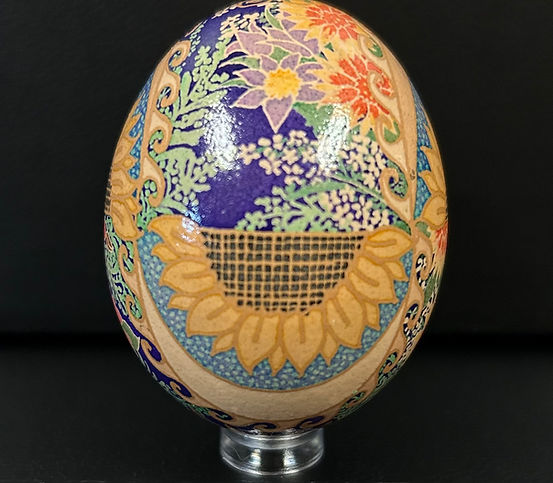
This avtorsky pysanka was written for artist Brianna LaPlante of Fishing Lake First Nation in Saskatchewan (Treaty 4), whose work and collaboration with Ukrainian newcomer Andrian Makhnachov deeply moved and inspired me. Together, they created a kokum scarf design - a floral scarf tradition deeply connected to Métis and Indigenous prairie communities. Floral scarves became established on the Canadian prairie through Ukrainian and other Eastern European settlement and, through trade, friendship, and cultural exchange, came to be embraced by many Indigenous communities as enduring symbols of grandmothers, resilience, and cultural continuity.
Canada’s prairie provinces have been home to one of the world’s largest Ukrainian diaspora communities since the late nineteenth century. Brianna and Andrian’s collaboration reflects a relationship that continues to evolve today, celebrating both Indigenous and Ukrainian cultures through prairie florals while acknowledging a shared prairie history. Brianna’s scarf design incorporates flowers connected to Treaty 4 territory, while in this pysanka I chose flowers from Treaty 7, where I live in southern Alberta. Many of these flowers also exist and hold symbolic meaning within Ukrainian pysanky and folk traditions, creating another point of connection across cultures, landscapes, and generations. To me, this egg reflects the relationships between First
Nations communities and generations of Ukrainian settlers, their descendants, and today’s newcomers on the Canadian prairies. Over more than a century, Ukrainians arrived on the Canadian prairies in successive waves, each carrying histories shaped by empire, famine, war, displacement, and perseverance. Throughout that same history, Indigenous peoples here continued to endure the ongoing realities of colonialism and
dispossession. Despite these difficult histories, there were also moments of exchange, neighborliness, shared knowledge, and mutual influence that became woven into prairie life. In this pysanka, I wanted to honour that spirit of connection through prairie flowers, sunflowers, movement, and traditional symbolism, reflecting the idea of cultures, stories, and relationships continuing to grow alongside one another across generations. FLOWERS Sunflower The sunflower is one of the central symbols in this pysanka, representing warmth, life, resilience, and continuity. In Ukrainian tradition, sunflowers are strongly associated with the sun itself, abundance, and protection, while
on the Canadian prairies they have also become a symbol of Ukrainian identity,
migration, and endurance. Here, they also reflect the shared prairie landscape
connecting Treaty 4 and Treaty 7 territories. Wild Rose Wild roses appear throughout the design as symbols of love, vitality, and relationships. As Alberta’s provincial flower, they connect this egg specifically to Treaty 7 territory and the prairie landscape where I live. Roses and flowering motifs are also deeply rooted within Ukrainian pysanky and folk embroidery traditions, where they often represent beauty, renewal, and the feminine principle. Rose Hips Rose hips symbolize protection, healing, endurance, and nourishment. In both prairie and Ukrainian traditions, they carry associations with survival through difficult seasons and the ability to sustain life and community. Crocus
The crocus, one of the first flowers to emerge after winter on the prairies, represents renewal, hope, and resilience. It reflects survival after hardship and the return of life following darkness or dormancy. Its appearance in this pysanka also speaks to cultural continuity across generations. Sage represents cleansing, wisdom, grounding, and spiritual protection. Across many cultures and traditions, including Indigenous traditions of the prairies, sage carries deep spiritual significance connected to healing and purification. Within this pysanka, it symbolizes respect, reflection, and the importance of approaching cultural exchange with care and sincerity. Yarrow is associated with healing, protection, interconnectedness, and the strengthening of community bonds. Traditionally used medicinally across many cultures, it reflects the idea of knowledge passed between generations and the sustaining relationships formed
through shared experience and care. Blanket Flower Blanket flowers symbolize
endurance, adaptability, warmth, and the ability to thrive in harsh environments. Their bright, sun-like appearance reinforces themes of resilience, survival, and beauty rooted within the prairie landscape. Traditional Symbols * 8-part division: Balance, harmony, order, and the cyclical nature of life. * Rozha (ruszha): Ancient sun symbol representing life, growth, beauty, harmony, and spiritual light. * Hidden sun/spider motif: Life, warmth, creativity, protection, patience, and artistry. * Eternity bands: Eternity, continuity, and the
unbroken passage of generations. * Bezkonechnyk (meander / waves): Water,
movement, journeys, protection, and the ongoing flow of life. The endless line
symbolizes continuity and is traditionally associated with pathways so winding that evil cannot find its way from them. * Sieve pattern: Protection and the separation of good from harmful forces. * Dots: Seeds, stars, blessings, abundance, and life-giving energy. Traditional Colors * Red / orange: Joy, vitality, passion, strength, and love. * Yellow /gold: The sun, warmth, harvest, prosperity, and light. * Black: Eternity, endurance, remembrance, and connection to the spiritual world. * White: Purity, light, innocence,
and spiritual clarity. * Green: Spring, renewal, growth, hope, and new life. * Brown: Earth, stability, humility, and connection to the land. Contemporary Colours * Blue: Sky, water, spirituality, health, calm, and emotional depth. * Turquoise / teal: Healing, openness, connection, and balance. * Purple / violet: Spirituality, wisdom, mystery, and transformation. * Pink: Affection, tenderness, friendship, and care. Method Written with
kistky and beeswax, then dyed and selectively acid etched.